EIFS repair · Boise, ID
EIFS and synthetic stucco repair
Finding damage in synthetic stucco is worrying, especially after everything written about 1990s EIFS houses. Most damage is local and repairable with the right method. Call us and we'll come out, check what's behind it, and put the repair and the price in writing.
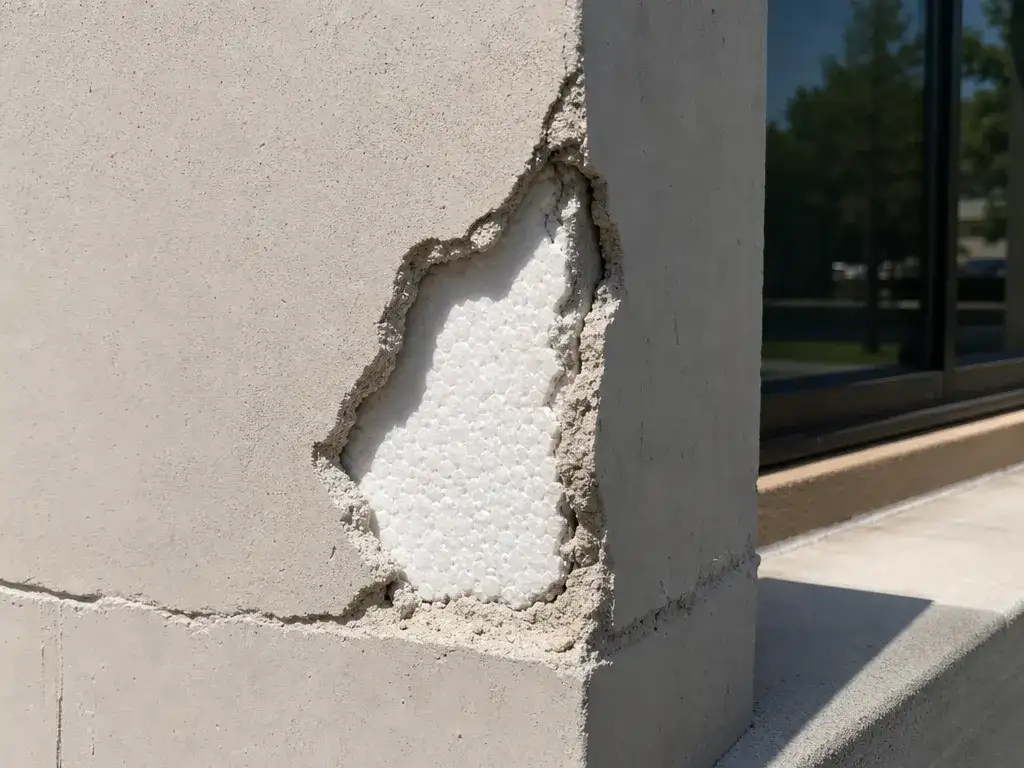
Boise Stucco Pros repairs EIFS across the Treasure Valley, where so much of the housing went up after 1990. That covers 92% of Meridian's homes. EIFS is foam board under a thin, mesh-reinforced coating, and it's repaired differently from cement stucco. Boise's siding permit form even asks about EIFS as its own question. Patch foam like stucco, and the patch fails.
EIFS repair typically runs $30–$50 per sq ft. It runs higher when the foam or the sheathing behind it is wet.
Prices vary with the type of repair, how far the damage goes and the finish you want. Your number is confirmed at the walkthrough, never fixed on this page.
Is it EIFS or stucco?
Knock before you get a quote. A hollow tap usually means foam, and foam needs an EIFS repair, not a stucco patch.
Tap it
A hollow sound suggests EIFS; a hard, solid sound suggests cement stucco. Cement board also sounds hard. Don't tap foam trim shapes, which are often added onto hardcoat stucco.
Press it
EIFS can give slightly under a hard thumb press; stucco doesn't. Inspectors report it, but it's not definitive.
Look behind a fixture
With a light fixture or outlet cover off, white foam behind the finish means EIFS. Metal lath and building paper mean stucco.
Check the joints
EIFS joints are usually sealant over backer rod. Hardcoat control joints are often metal. Suggestive, not conclusive.
Barrier or drainage?
They look nearly identical from outside. Gaps, flashing or perforated trim at the base of the wall hint at a drainage system.
One caution: an EIFS-brand finish applied over hardcoat stucco doesn't make the wall EIFS. Cement stucco with cracks or holes is covered on the Boise stucco repair page.
Not sure what's on your walls? We can tell on site.
Barrier vs. drainage EIFS
Barrier EIFS
The original system: foam glued directly to the sheathing, with the outer face and sealant joints expected to stop all water. Water that gets past the face is trapped against the wood.
Idaho's adopted residential code (2018 IRC R703.9.1) limits barrier EIFS to concrete or masonry walls. On a wood-framed house it's a legacy system current code no longer allows for new work.
Drainage EIFS
Adds a water-resistive barrier and a drainage cavity behind the foam, from vertical adhesive ribbons, grooved foam or textured wrap, draining to perforated flashing at the base. Drainage systems are now the predominant EIFS installed.
Code (R703.9.2) requires it on all other walls, meaning wood framing, with at least 90% drainage efficiency per ASTM E2273. Both types must stop at least 6 in. above finished grade.
If a barrier EIFS on a wood-framed house is getting wet, patching won't add drainage. A conversion means removing the old system. The 1990s problems trace to barrier systems: inspectors in New Hanover County, North Carolina, began moisture-testing EIFS homes around 1995–96 and found excessive moisture in nearly all of the 31 houses checked, several with substantial rot. Class actions followed, and codes changed.
How EIFS damage gets repaired
An EIFS hole gets cut out, filled with new foam, re-meshed with an overlap onto the old mesh, and refinished. A base coat and finish over the hole alone will fail.
We match the repair sequence to the system on your wall.
Cut back to sound material
Razor-cut through all layers to the substrate, or to the barrier on a drainage system, and inspect what's underneath.
Fix anything wet
If the foam or sheathing is wet, cut back to the wall and repair studs and sheathing first. Base coat and finish over a hole alone will fail.
New foam
Replace the EPS foam, set in base-coat adhesive.
Overlap the mesh
Embed new mesh in base coat, lapped at least 1 in. onto the existing mesh. High-impact mesh is used at grade and where damage repeats.
Feather and finish
Grind the old finish back at least 3 in. without cutting into the mesh, then re-finish and match the texture.
Seal joints correctly
Sealant goes onto the base coat, not the finish, which softens when wet. Joints are typically 3/8–1/2 in. with backer rod.
Most EIFS leaks start at the sealant joints around windows, not in the middle of the wall. EIFS is not a DIY product. When water has reached the framing, the job becomes remediation.
Hole, crack or soft spot in EIFS? Get a written repair estimate.
Bird damage and impact holes
Woodpeckers, mostly northern flickers, can break through EIFS into the foam and the substrate behind it.
Repairs at grade and on walls that get hit repeatedly often use high-impact mesh, and puncture-resistant systems exist for exactly this. Flickers are federally protected, so deterrents come before patching.
What EIFS repair costs
EIFS repair typically runs $30–$50 per sq ft.
These are items that could affect the price: whether the foam or sheathing is wet, barrier vs. drainage, the size of the damaged area, finish matching, and whether the wall needs a full recoat. We will walk through all of them with you and provide an itemized estimate. A barrier-to-drainage conversion is effectively a re-clad and priced like one. For context, a typical Boise stucco repair job runs $1,350–$2,150.
Prices vary with the type of repair, how far the damage goes and the finish you want. Your number is confirmed at the walkthrough, never fixed on this page.
EIFS questions
How do I know if my house is EIFS or stucco?
Tap it: hollow usually means EIFS, solid means stucco. To confirm, look behind a removed fixture for foam. We can settle it on site.
How much does EIFS repair cost?
It typically runs $30–$50 per sq ft, more if foam or sheathing is wet.
Can barrier EIFS be converted to drainage EIFS?
Not in place. Converting means removing the old system and installing a drainage system, which is a big job, priced like a re-cladding, not a repair.
Can you paint EIFS?
Yes, with a breathable acrylic, ideally the same finish product. Avoid oil-based paint, and test first.
Is EIFS bad?
Its 1990s reputation came from barrier systems trapping water, starting with moisture testing of homes in Wilmington, North Carolina. Drainage EIFS installed to the manufacturer's details is what code requires on framed walls today.
How should EIFS be cleaned?
Low pressure, under 500 psi, with the tip at least 12 in. from the wall. Closer or harder can damage the finish.
Free EIFS repair estimate
We'll respond within the same business day and schedule a time to come out, look at the wall, and talk you through the process. Rather talk? (986) 290-4810.